It’s Called Sanskaar. But Why Do Women Feel Controlled?
If you look at human societies long enough, from small agricultural communities to modern nations, one pattern appears with uncomfortable consistency: Women seem to end up with less power. This is not confined to one civilization or religion, it keeps showing up in every era. The tools change, the justification changes, but the hierarchy remains.
And that’s where it starts to feel a little strange. We are educated, constitutionally modern, scientifically informed, and yet we are not very different. Sometimes we don’t even realise how deeply rooted patriarchy is in our culture.
So what exactly is going on?
The Strength Argument
The most common justification for patriarchy is physical dimorphism: men are, on average, stronger than women. This explanation appears intuitive, but it doesn’t explain much.
-
For most of human history, survival wasn’t about lifting the heaviest object. Endurance, coordination, ecological knowledge, and cooperation mattered more than raw power. Anthropological evidence suggests women often provided 60–80% of calories in hunter-gatherer societies. They participated in early agriculture and were pivotal in food processing and storage.
-
Women are biologically more resilient. They have a stronger immune response, endure physical strain & pain more frequently, and have longer life expectancy across cultures and eras.
-
Muscle power doesn’t explain exclusion from non-physical domains like priesthood, law, philosophy, governance, or knowledge production. None of these requires lifting stones or swinging weapons. If muscle were the real reason, women would have been excluded from battlefields—but not from ideas, rituals, or leadership.
Anyone who has watched women in rural India work knows how hollow the muscle argument sounds. Women carry water for kilometers, transplant rice seedlings bent over for hours, cook on open fires, give birth without anesthesia, and return to work within days.
If strength determined status, the women who survived this routine for decades should have been revered as superhuman. Instead, their labor was normalised, unpaid, and invisible.
The Aggression Idea
Another popular argument is that men are more aggressive, and aggression is often a means to gain power. It sounds neat, almost believable, but let's look at it with an example:
A man gets into an argument with a shopkeeper, a stranger, or a neighbor and refuses to back down. At home, family members retold the incident almost with admiration and respect: “He doesn’t take nonsense from anyone.” It becomes part of his image. A sign of toughness. But imagine the same man returning home late, drunk, creating chaos, and shouting at family members. Suddenly the story changes. No one calls it strength anymore. No one praises his dominance. Instead, people get anxious, embarrassed, and concerned.
The aggression that looked admirable in public feels threatening in private. This contrast reveals something important, aggression is not leadership. It may be admired from a distance or mistaken for strength. But up close, people usually recognize it for what it is: instability wearing the costume of power.
In fact, archaeological evidence suggests early Paleolithic human societies were relatively egalitarian. Most of these societies actively suppressed aggressive males. Sometimes through ridicule, ostracism, or in extreme cases by execution.
Similar patterns can also be found in nature, among other species.
- In elephants, herds are led by older matriarchs in family groups. Adult males usually live separately or loosely connected.
- Bonobo societies are heavily influenced by female coalitions. Individual males may be strong, but females often dominate collectively.
- For spotted hyenas, survival depends on coordinated hunting and territorial defense. Still female-centered clans.
The Dependency Assumption
The idea that women “needed men” is culturally powerful, but biologically weak. There is no genetic evidence of an innate female dependency requiring male dominance. Women can gather resources, earn income, make decisions, defend interests, raise children, lead groups, build alliances, and survive independently. Across history and today, millions do.
Dependency is not a cause → It is an outcome.So if it’s not strength, or aggression, or something coded in genes, then what is it? What is this force that seems strong enough to quietly shape entire systems, yet rarely gets questioned?
The Problem of Certainty
Biology distributes control uneven Women have greater biological involvement in reproduction (pregnancy, birth, early childcare, etc.), and men historically controlled violence and external defense (weapons, organized force, territorial expansion). In hunter-gatherer societies, people were mobile, property was minimal, resources were shared, and children were often raised communally. If a man died, his group absorbed dependents, and no land or surplus needed to be “passed down”. In such systems, certainty had low economic value, and control over women offered no material advantage. That’s why we observe relatively egalitarian gender relations.
As humans moved from foraging to agriculture (Paleolithic → Neolithic), land stopped being just land; it became property. Surplus could now be stored, and inheritance began to matter. For the first time, people needed to answer, “Who is going to inherit this?” Once that question entered the system, incentives changed. Lineage began to determine access to resources, and wealth started to accumulate over generations.
This gave rise to entitlement, and new minority groups emerged, holding disproportionate amounts of resources, power, and influence in society, often occupying top positions in politics. What we might casually call elites.
You can still notice how instinctively we think this way. The moment something valuable is mentioned — land, a house, savings, the conversation almost automatically shifts to who it will go to. Not who needs it most, or who contributed the most.
And once that question takes hold, another one quietly follows: How do we decide who gets it? There were multiple possibilities.
- Make inheritance communal
- Share property beyond bloodlines
- Inheritance by the firstborn (Primogeniture)
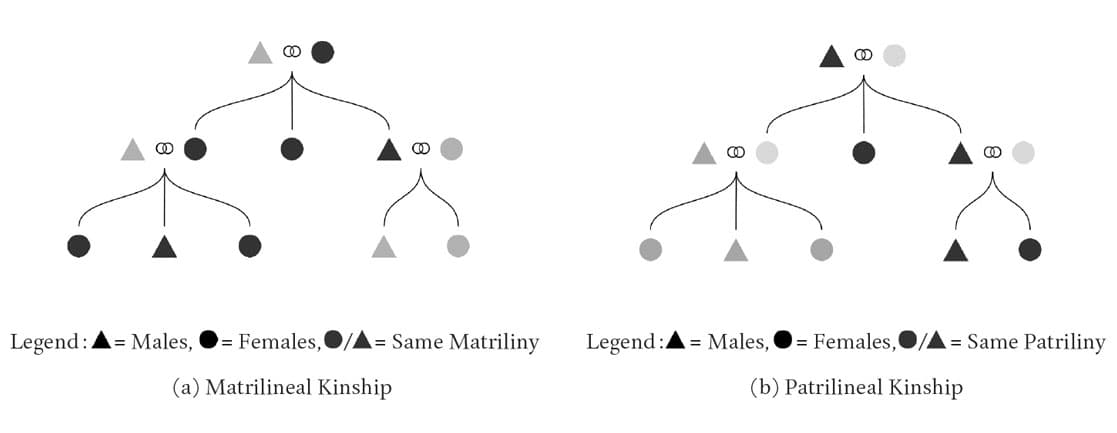
Some societies experimented with these. But two systems stand out— matrilineal and patrilineal kinship.
| System | Certainty | Power Concentration | Gender Control |
|---|---|---|---|
| Matrilineal | High | Low–Moderate | Low |
| Patrilineal | Low (biologically) | High | High |
| Communal | Irrelevant | Very Low | Very Low |
| Primogeniture | Medium | Very High | Very High |
From a purely rational standpoint, maternal lineage is certain; no policing is required, and no anxiety over biological parentage. So, why not choose it? Let's understand what happens in a matrilineal system:
- A man’s inherited property passes to his sister’s children
- His wife’s children belong to her lineage
- A husband’s authority over wife and children is weaker
This creates a problem for male elites. They fight, accumulate wealth, and defend territories, but they cannot fully guarantee that their own sons will inherit what they built. In a power hierarchy, that uncertainty is unacceptable. This is where lineage begins to shift from biological reality to political design. Patrilineal inheritance did not endure simply because it was the most logical arrangement. It endured because it was highly effective at concentrating power, property, titles, and alliances within a controlled male line. By defining legitimacy through the father’s side, elites could organize succession, reduce disputes, preserve estates, and keep authority circulating within the same structure.
Certainty of fatherhood
This uncertainty mattered most in societies where inheritance passed through the male line. If a king transferred wealth and power to a son who was not biologically his, then property, titles, and political continuity could slip outside the intended lineage. For that system to function, a man had to be confident that his heir was biologically his. In the ancient world, there was no direct way to verify paternity.
Maternity, by contrast, was visible.
- Fertilization happens inside a woman’s body
- Birth is observable
- The mother is undeniable
Fatherhood could only be assumed through trust, custom, or social recognition. That difference between visible motherhood and uncertain fatherhood shaped many inheritance systems, marriage rules, and social norms around sexuality. Many agrarian societies responded with what they saw as the easiest and most enforceable solution: control women. Restrictions on movement, regulation of marriage, pressure around chastity, control over reproduction, and surveillance of female behavior often emerged because women were treated as the variable through which paternity certainty could be increased.
Institutions Codified Control into “Culture”
Once this control existed, it didn’t remain just practical it slowly began to present itself as moral. Slowly, religion sanctified it, law normalized it, philosophy rationalized it, and language encoded it. What began as an economic and reproductive management tool got transformed into “This is how the world is meant to be.” This transformation is gradual enough that no one can point to the exact moment it happened.
You can see it in something as simple as a surname. A woman changes her surname after marriage. It’s introduced as a formality, a custom. Over time, the word itself starts to carry meaning. The surname begins to signal belonging. Belonging starts to define identity. And after a point, no one really asks why it changed; they just do it because “this is how things are done.”
Every girl must have been given advice:
- Don’t stay out too late.
- Dress properly.
- Think about the family.
It sounds like care. And maybe it is. But over time, it also starts to define boundaries. Quietly, repeatedly, without ever explaining where those boundaries came from.
If you think about it rationally, this explains a question muscle power never could: Why were women excluded from priesthood, law, and politics? Because knowledge creates power, power enables resistance, and resistance threatens control. A woman who understands law, theology, or governance can’t be easily confined. So exclusion was not about ability. It was about risk management. Interestingly, different cultures arrived at the same solution independently, just as they independently invented farming.
Modern societies no longer rely on lineage-based land inheritance, yet patriarchy remains because institutions outlive their original function, power systems resist self-dismantling, and cultural narratives lag behind material reality. Technically, we are running obsolete software on modern hardware.
Womanhood did not lose status because women were weaker, less capable, or dependent. It lost status because:
- Reproductive control became economically valuable
- Certainty mattered more than fairness
- Control was easier than trust
Maybe patriarchy is not proof of male superiority. It is evidence of historical fear, scarcity, and insecurity hardened into tradition. Once installed, it learned to justify itself. The strange part is not that patriarchy exists, but how easily something functional becomes unquestionable. For so long, a logistical solution quietly passed as a moral truth.
And until we recognize that difference, the system will continue— not because it is natural, but because it is familiar.

Written by
Piyush Tyagi